
| Programme of EventsMembershipPublicationsEditorial BoardOfficers | Library |
|
|
Hampshire Field Club & Archaeological Society |
| Registered Charity number 243773 | HomepageArchaeologyHistoric Buildings LandscapeLocal History |
 |
Forest of BereJohn Pile led a visit to the Forest of Bere on 31st May 2008. A fuller account of the visit will appear in the Landscape pages of a future edition of the Newsletter. Here there is an account of one of the most ancient trees in the forest. The Bere Oak
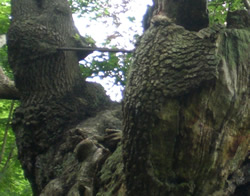 Under the former care regime, three large props were used to support
the upper boughs. Cross-bracing, as can been to the right, was also used to
maintain these boughs. Currently crown reduction is considered the best way to
enable survival. Removal of the extra weight of the crown will be of benefit and the
tree will be stimulated to produce new growth as has happened lower down. Finally,
Sycamore trees, which were causing problems of shading, have been removed.
Under the former care regime, three large props were used to support
the upper boughs. Cross-bracing, as can been to the right, was also used to
maintain these boughs. Currently crown reduction is considered the best way to
enable survival. Removal of the extra weight of the crown will be of benefit and the
tree will be stimulated to produce new growth as has happened lower down. Finally,
Sycamore trees, which were causing problems of shading, have been removed.
For anyone interested in very old trees, the Ancient Tree Forum, has wealth of information. |
|
| Contact Any questions about the Landscape Section? Then email Mike Broderick Landscape Section Chairman |
||
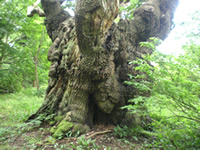 This example of an ancient oak is a Sessile Oak - Quercus petraea. Hampshire, in a
climatic zone where the maritime and continental influences mix, has a richer mix of
trees than some areas. Using
dendrochronology the Bere Oak has a likely age of 995 years. It is a
lapsed pollard as can be seen in the photograph. Pollarding, which can at least double
the life of a tree, was used as part of a system of wood pasture to protect the
leaves from grazing.
This example of an ancient oak is a Sessile Oak - Quercus petraea. Hampshire, in a
climatic zone where the maritime and continental influences mix, has a richer mix of
trees than some areas. Using
dendrochronology the Bere Oak has a likely age of 995 years. It is a
lapsed pollard as can be seen in the photograph. Pollarding, which can at least double
the life of a tree, was used as part of a system of wood pasture to protect the
leaves from grazing.