
| Programme of EventsMembershipPublicationsEditorial BoardOfficers | Library |
|
|
Hampshire Field Club & Archaeological Society |
| Registered Charity number 243773 | HomepageArchaeologyHistoric Buildings LandscapeLocal History |
 |
Newsletter 44 - Autumn 2005 The Roman Glass Furnace Project Mark Taylor & David Hill In the Spring and early Summer of 2005, we constructed and ran two Roman wood-fired glass furnaces at our workshops in Quarley. The project, staffed by volunteers, ran for several weeks in an attempt to discover information about the working conditions of ancient glassmakers. The glass furnaces were based on information gleaned from the many excavations of Roman furnaces in recent years, using a quantity of original Roman bricks and tegulae (kindly supplied by archaeologists), and clay daub. They were fuelled with wood, including beech and ash, and ran for 24 hours a day. Glass was blown by Mark during daylight hours. 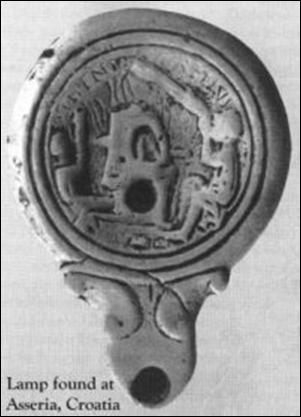
One of the very few depictions of a Roman glass furnace is found on a fired clay oil lamp of the 1st century AD from Asseria, Croatia (now in Spalato Museum, inv.1094/30, shown below). Another lamp from Ferrara, Italy, has the same design (Museo Archeologico Nazionale, Ferrara, inv. 52196). The whole experiment was thoroughly recorded, with attention being paid to aspects including furnace construction, fuel consumption, glass melting and working cycles, temperatures achieved, durability and efficiency of the furnace superstructure and working practices developed by the team. In order to preserve the glass vessels made, a wood-fired annealing oven was also built and operated. The tank furnace and annealing oven were partially dismantled at the end of the experiment so as to record the remains for comparison with excavated remains of Roman furnaces. They will be left exposed to the elements for a year to observe the weathering processes before final dismantling. No experimental archaeological Roman glass project involving a furnace and workshop has ever been conducted in Britain over such an extended period, and we hope that the published results will prove useful to glass technicians, historians and archaeologists alike. 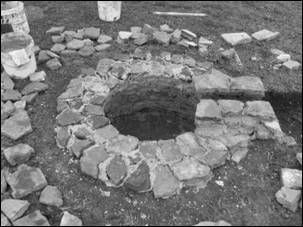
We began building the furnaces (right) in February 2005 on a part-time basis, with the aim of completing them in time for lighting in late April. By late March, and by then working on them full-time, the firing chambers were built and the superstructures had risen to pot/tank level. Once the firing chambers had been lined with tiles, progress was quicker. The walls of the superstructures were made from a clay, sand and hay mix and built into domed structures (below). 
The main structures were finished by the third week of April. By the end of the month the thermocouples had been fitted and the various covers and doors were ready. Although these furnaces had been carefully planned, we found that we adapted the plans as building progressed. Both furnaces were lit on 26th April. The Pot Furnace: This furnace was based on the ground plans of rounded furnaces with horizontal stoke hole entrances such as have been found in France The shelf (siege) for the pots is the top of the firing chamber wall which was corbelled inwards. There is no direct evidence for this method of constructing a siege, but the pots have to sit on something! One of the furnaces excavated at Lyons, France does have a small section of above ground wall which corbels inwards. The pots that rested on this shelf were based on a pot found at the late Roman glassworking site of Hambach Forest, near Cologne. The pot chamber was a domed structure entirely composed of a clay/sand/hay daub, with two gathering holes and two smaller holes let into it for reheating small items. The advantages of daub were that the structure could be shaped as needed as it was being built and it formed a strong monolithic structure when dried and fired. The Tank Furnace: Although there are an increasing number of Roman glassworking sites being identified, there is very little in situ superstructure and the evidence for pots in the earlier Roman furnaces is scarce. For this reason, other ways of holding the molten glass have to be considered. The tank furnace (below) is the alternative. As with the pot furnace, the firing chamber was built using tiles, but also incorporated stone. The ground plan was oval, a type seen on many sites such as at Lyons, and the stoke hole had an inclined chute, often the case with furnaces such as those found at Augst, Switzerland. The superstructure was built from daub. This furnace also had an annealing oven attached which used waste heat. Remains of a similar arrangement are seen on the furnace from Lyons. In the event the tank furnace failed through shrinkage and cracking of the tiles, but was kept going to heat the annealing oven Glassblowing: As noted above the furnaces were lit on 26th April and run at low temperatures for two days. At the end of this period, the temperatures were raised over a further two days to about 1050°C and the glass was introduced. On 1st May, we started blowing glass. The overriding observation was that teamwork was the most important consideration. The back-up crews of stokers (doubling as wood-gatherers) were essential (and we are extremely grateful to the people who volunteered their time - on both night and day shifts), and their communication with the glassblowers was very necessary. The pot furnace in particular ran well at between 1000°C and 1060°C in the pot chamber, but to raise the temperature above 1100°C was hard work, so it was usually kept to these limits. The glass we used was one that reproduced the composition of Roman glass. We found that it needed a night-day-night cycle at temperatures above 1000°C in order to be ready for blowing. This length of time produced a glass quality comparable with original Roman glass, with small bubbles (seed) still present, but kept down to acceptable levels. The tank furnace was needed to run the oven, so a cycle of dropping the temperature at night to 600°C and raising it during the day to about 1000°C - 1050°C was evolved. The night stokers cooled the oven down, removed the previous day's glass and re-heated the oven in readiness for the coming day. Wood was weighed in ten kilo batches, and the amount burned was recorded for both furnaces:
Several species of wood were used, including beech, ash, walnut, chestnut and yew. 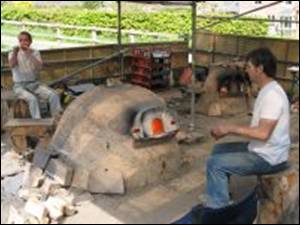
The glassblowing itself (left) was a voyage of discovery! Skills had to be adapted and developed to cope with conditions such as working close to the furnace, using the gathering hole for reheating, using short, thin gathering and blowing irons and working with several irons at a time. In addition, one had to cope with the wind blowing hot gases into one's face. This is a very good argument for inferring that ancient furnaces were enclosed in substantial shelters! 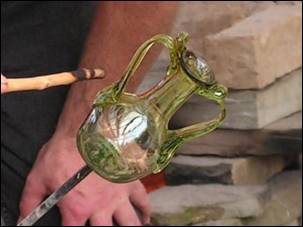
By the end of the glassworking phase of the project, the vessels were much improved on those blown at the start of this phase, and the luxury of more time would have resulted in a wider variety of vessels and more precise control of the glass. Future plans - the Pot Furnace: As this will be re-fired in 2006, we could not section this furnace. However, it was possible to observe the inside of both the pot and firing chambers. A blue-grey glazed pot chamber wall was noticeable. Cracks in the wall were due to shrinkage on firing, but did not affect the furnace performance during the three weeks. The pots experienced very little wear, and the two that failed probably cracked due to thermal shock (in the case of one pot, a hairline fracture was present before firing). The daub lining was partially successful and further experiments with different clay mixes may result in more success in preventing glass leakage. The Tank Furnace: Using a saw, we sectioned this furnace to reveal striking colour changes through the thickness of the wall. They are due to the temperature gradient through the wall as part of the heat loss process. The tiles we exposed had shrunk and cracked on the portions facing into the firing chamber, indicating that they had been taken to a higher temperature than they had when originally fired. The extent of damage to the tank was revealed: several large fissures had opened, providing exit points for the glass. The annealing oven did the job of annealing the vessels, but will be demolished and replaced in 2006. The project has been sponsored and funded by Find out more at http://www.romanglassmakers.co.uk |
|
 One method of creating a tank furnace is based on evidence from London in the form of a large tile with a layer of glass which appears to have been inserted into the wall of a furnace and had sidewalls built around it to create the tank. We decided on a similar approach, but using unfired daub with a high proportion of clay to build the tank. This should have removed the problem of unfired clay pulling away from a fired clay tile, avoiding the formation of gaps which would allow the glass to escape.