| Programme of EventsMembershipPublicationsEditorial BoardOfficers | Library |
|
|
Hampshire Field Club & Archaeological Society |
| Registered Charity number 243773 | HomepageArchaeologyHistoric Buildings LandscapeLocal History |
 |
Newsletter 44 - Autumn 2005 Basing House - The Grange - 2005 Excavation David Allen After a year without an excavation this note describes the latest piece of work in the programme which is gradually revealing the plan of the Restoration period mansion built near the Great Barn at Basing by Charles, 6th Marquis of Winchester. The dig took place between 16 May and 5 June, and was the fifth season featuring the Basingstoke Archaeological & Historical Society. More than 40 individuals helped on the excavation and a great big thank you goes to all those who participated, whether old hands or new faces.
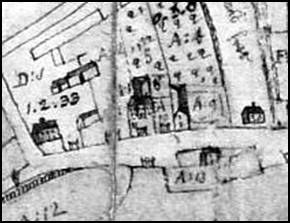
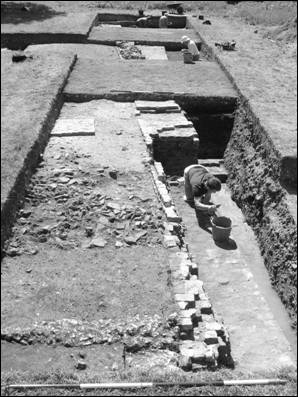
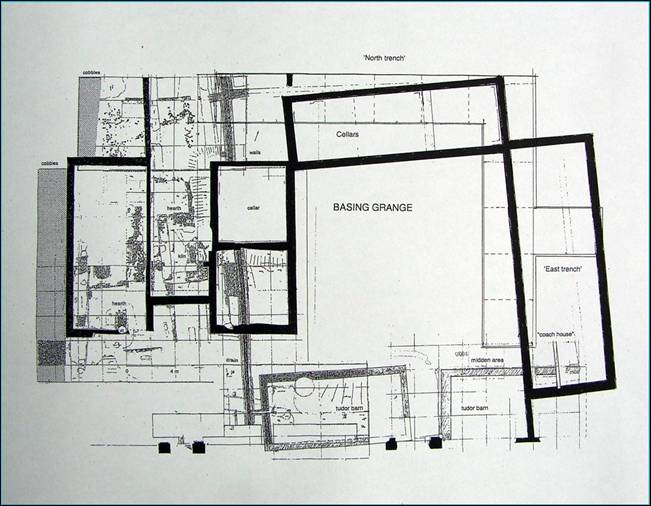
The principal objective of this year’s dig was to find, with an east trench, the full extent of the ‘coach house’, a large ancillary building to the east of the mansion. Additionally a north trench linked the ‘coach house’ and mansion and encompassed Time Team trenches 2 and 3 (dug in 1999), to see if there was any trace of a structure represented by a single line on the Godson survey. The ‘coach house’, though thoroughly demolished and robbed, survives below ground level as a series of footings and trenches. These indicate a building c 22m (67’) long and 7.7m (23’) wide. A compacted surface of pebble gravel was again a feature of the western side of the building but no such surface was evident to the east. A chalk wall footing which appears to run along the middle of the structure is of Tudor date and heads for the corner of one of the Tudor barns, previously noted alongside The Street to the south. The north trench revealed a totally unexpected complex of cellars. Essentially they occupy a rectangular building 18m (55’) x 6m (18’) although minor details and any internal walls remain hidden. The cellar floors are more than 1.5m from the present ground surface and consist of distinctive large bricks and tiles. A prominent gutter exists at the foot of each wall. The cellars were filled with a mix of mortar, broken brick and tile, with occasional layers of burnt material. Finds included fragments of glass bottles, pottery, clay pipe etc.
The cellars share the same N-S wall as the ‘coach house’ and are built at right-angles to it. The projected layout would tie the southwest corner of the cellars with the northeast corner of the mansion, and to a wing of the house which is itself cellared. The mansion house cellar, however, had a beautifully finished patterned floor, quite unlike the rough paving of the new discoveries. The cellars are clearly contemporary with the mansion house/’coach house’ complex and presumably housed wine and beer and served as a cold store. At the present time the floor is just below the water table and this may well have been a problem in the 17/18th centuries. Two brick-built drains intended to carry run-off water away from the area were also found at the northern limits of the dig. Finds
Conclusion
Fig 3. Sketch plan showing the newly discovered cellar range linking the main house and ‘coach house’. |
|||||||