| Programme of EventsMembershipPublicationsEditorial BoardOfficers | Library |
|
|
Hampshire Field Club & Archaeological Society |
| Registered Charity number 243773 | HomepageArchaeologyHistoric Buildings LandscapeLocal History |
 |
Newsletter 43 - Spring 2005 The Siting of Zionshill Copse Iron Age Enclosure Robert Garnham
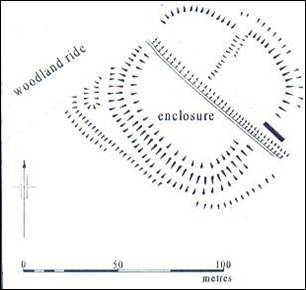
The land in the vicinity of the enclosure was boggy, riddled with streams, of varying soils and levels, covered with sedge; poor ground for cattle or crops. It is difficult to see how the community who built the defences would have been able to support themselves by conventional farming. In addition, the extensive surveys and excavations in the locality (Rawlings, 2003), and a small exploratory survey of the outer ditch (Entwhistle, 2004), have not produced any evidence for industrial activity at the site. In that case, could there possibly have been other goods produced locally, that sustained the enclosure's occupants? Zionshill Copse enclosure is sited on the edge of a small piece of land, leading into the largest part of a wetlands area, formed in the lowest part of a water catchment area. This is created by the three lines of hills forming a) the east side of the valley of the River Test, b) the west side of the River Itchen, meeting at Hut Wood, and c) part of the South Downs from Winchester to Farley Mount Country Park. These chalk hills shed rainwater run-off into the basin, but also absorb some which rises as springs from North Baddesley across to Otterbourne. This water then runs down numerous rills and dells to form seven small streams that become five, then two, and finally one. The sources of these streams are: Fryern Hill, and Hiltingbury, Cranbury Park, Silkstead and Hursley, Hursley Lakes and Ampfield Wood, North Baddesley Church and Bucket's Corner (the officially recognised source of Monk's Brook), Sky's Wood, Great Cover, Chilworth and Hut Wood. At Chandler's Ford, the single stream cuts through the line of hills from Hut Hill to Winchester, making a pass between Fryern Hill, South Hill and Chandler's Ford Hill. This is the only exit from the catchment basin. Over a large area immediately above this pass, water slowed and pooled before being able to escape, so silt and clay was deposited and a large area of peat formed in the lower part. More than two thousand years ago, the erosion of the pass was less than today, and drainage above it would have been restricted, ensuring that wetlands existed adjacent to the enclosure (Fig 2). 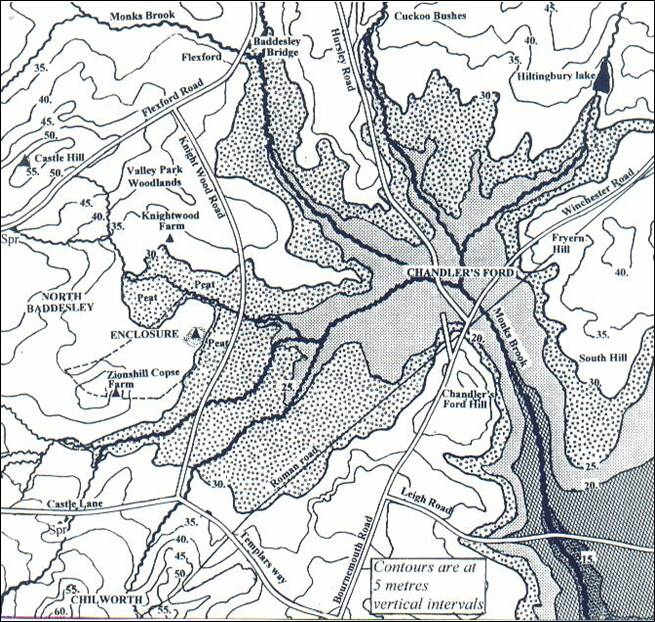
Fig 2. Topographical map showing wetlands (shaded) in the vicinity of the enclosure and the outlet of the catchment area (Drawn by Robert Garnham). Today Monks Brook water is rather acidic and does not support much plant, fish, or other animal life. The springs were more numerous during the Iron Age than today though, with surface run-off from the chalk hills unhindered by modern demand and infrastructure. As a result, the water would have had a better pH level. Given this, and with a larger expanse of water in the basin, animal life and oxygen producing plants would have been far more prolific. With its particular environmental characteristics, it would have been excellent as a source of fish and wildfowl for market. Systems could have been developed throughout the area with dams producing small lakes.Also, a system of control in the pass could have regulated the level of water, holding a larger lake above the head of the pass. This could have been done in conjunction with it becoming a ford (Newsletter 42. 2004). Until recently, there were many remnants of this wetland area above the pass, in the form of ponds, marshes and flooding after heavy rain. With a myriad of freshwater shrimps, insect larvae, and water snails throughout the shallow waters, it would have been attractive to ducks, swans, geese and many other wildfowl. These could have been harvested. There would also have been brown trout, and the many different species of coarse fish that are still in the area, with the now absent crayfish. Apart from this edible and marketable fare, the freshwater of the River Itchen meets the tidal estuary at Mansbridge, and Monks Brook joins downstream of this, determining that migratory fish met the mouth of the brook and its fresh water first. This would also have stocked the area with salmon, sea trout, eels, elvers, and lampreys. For many years now, salmon and sea trout access to Monks Brook has been prevented by sluice gates at Swaythling Salmon Pool.
Anticipating these and many other routine natural events would guarantee bountiful harvests. Releasing dams to produce spates during dry periods would induce salmon and sea trout waiting for rain in the salt-water estuary, to run up the brook. Alternatively, if large gatherings of fish were driven into Monks Brook from the saltwater estuary and chased upstream through the pass, they could be diverted along streams to a convenient trapping and processing place. These would be repeatable and very productive operations, and enough successful breeding would take place in Monks Brook and the upper reaches of the River Itchen, for stock replenishment. The continuously running waters from the many vital springs with their breeding fish, creating the streams and wetlands rich in wildfowl would have been of considerable significance to the local populace. Today's record weight for a salmon is 46.8 kg (Ref 41037), 50kg for a sea trout (Ref 682), and it's probable that comparable weights were more attainable in prehistory; there would also have been greater numbers of wildfowl. All this produce could potentially create an extensive and heavy stock for processing and storage. Transport would be needed for transit to markets inland, and even possibly abroad through places like Hengistbury Head (Cunliffe, 1989). The viability of the immediate location could be the reason why Zionshill Copse enclosure was developed. The harvested stock and would be a rich prize for thieves, and this could have been a major reason for the enclosure needing fortification. Lastly, the enclosure's size and substantial fortification would be a symbol of the wealth and status attained by an established and successful people. References
| |||||