
| Programme of EventsMembershipPublicationsEditorial BoardOfficers | Library | Medieval Graffiti Survey |
|
|
Hampshire Field Club & Archaeological Society |
| Registered Charity number 243773 | HomepageArchaeologyHistoric Buildings Hampshire Papers LandscapeLocal History |
 |
Medieval Graffiti - Newsletter Articles - Vol 74, Autumn 2020Graffiti Findings from St Peter’s Church, Goodworth Clatford by Karen WardleyIn those heady, pre-lockdown days of February 2020, members of the HMGP visited St Peter’s church and such was the quantity and quality of the graffiti found there that a second visit was needed to complete the survey. Here follows a summary of our findings. The main body of the church consists of a flint-built nave and chancel, with north and south aisles, and an ashlar west tower with shingled spire. The south aisle arcade is dated to the late 12 th century, one arch having fine Norman dogtooth decoration. Pevsner, in The Buildings of England, Hampshire, states the church was once cruciform, the south transept arch being contemporary with, or possibly slightly earlier than the south aisle. The Purbeck marble font is also 12 th century. The north arcade is later, of the 14 th century. The tower was built c1540 with stone from Wherwell Priory, and pieces of carved Norman zigzag mouldings can be seen on the inside and outside, and another carved fragment in the chancel is probably from the same source. The south porch is dated 1872. There are fine carvings of a man’s and woman’s head on the capital of one of the north arcade pillars, and a bearded (green?) man at the west end. It is very difficult to date historical graffiti with any degree of certainty, but there appears to be a significant grouping of early graffiti on the south aisle pillar which supported the south transept arch. This includes a fine example of a cross within a triple circle, now sadly damaged, which is probably a consecration cross. Such crosses mark the places anointed with holy oil by the bishop when the church was consecrated or, as probably in this case, re-consecrated after alterations. There are also a large number of crosses, some within compass-drawn circles, including a finely worked quatrefoil. These might indicate marks left by individuals as signs of personal devotion or prayer. On the south face of this pillar is a small compass-drawn hexfoil shape or “daisy wheel”, a symbol thought to be apotropaic, used to ward off the Devil and evil spirits. (See Fig 1)
Not all the graffiti in this area has spiritual significance, and there is a drawing of a face on the west side of the same pillar, perhaps a caricature of a fellow parishioner? Another figure, more crudely drawn, its face in profile, was found on the south side of the pillar. There are also traces of writing on this pillar, but its worn condition, the possible use of abbreviation and the form of the lettering, make it hard to decipher. On the south face of the abacus at the top of this pillar are two overlapping Vs. This may be an invocation to the Virgin Mary (Virgo Virginum) although it could more simply be a capital W. There is much less graffiti on the other south arcade pillars, apart from a cross, some indistinguishable marks, and what appears to be a fleur de lys shape. Why there is so much more on one particular pillar is hard to say. Often, most graffiti occurs on the pillars closest to the church entrance, but this is not the case here. It could indicate the site of an earlier altar where people gathered to worship, or perhaps an earlier location of the font. The north arcade pillars have a smaller amount of graffiti. There are some possible, faint crosses incised into the pillar opposite the south door, so this might be where parishioners recorded a personal prayer on entering the space. There is also a large compass-drawn circle, which may be apotropaic. There is a tantalising area of graffiti on the pillar N3, which appears to include some text. The word at the base seems to read “hoby”. This was a medieval surname, so could represent someone’s name. Further study is needed. Church porches and entrance doorways are areas where medieval graffiti is commonly found. At St Peter’s however, if there was a medieval porch it was replaced by the current Victorian one. The only trace of graffiti here now is on the west side of the south doorway. This consists of an elaborate web of lines which some believe might represent the rigging of a sailing ship. On the exterior of the church tower were found two crosses. There are also, unusually, two Ordnance Survey benchmarks, at different heights. Although not true graffiti, we also recorded masons’ marks found on stonework within the nave, and in the tower on blocks which may have come from Wherwell Priory. There are also some good examples of marking out lines left by masons when carving decorative features, for example on the capitals of pillars. Perhaps even more significant than these early examples of graffiti however, are the pencil drawings and inscriptions left within the clergy vestry by the young men who acted as organ blowers, pumping the bellows, at the time of the second world war. There is a huge amount of graffiti, both on the plaster of the wall and scratched into the wooden organ casing, mostly dated to the 1940s. Many names are recorded, often more than once, and often described as organ blowers. Some names have later additions, showing which arm of the forces they have joined. One such example is R Mulford, who recorded and dated his name many times, from 1939 through the war years, and at some stage added that he served in the Royal Navy, on the HMS Britany (sic), travelling to St Vincent from Portsmouth. H Gibbs left his name, and a different hand has added beneath this “Comrade. Now a prisoner of war in Germany”. We were pleased to find that none of these names appear among those recorded on the war memorial as having lost their lives.
The interests of these young men are exemplified by the carefully drawn examples of different types of aircraft that they were obviously familiar with, there being a number of airfields in the vicinity. The helicopter shown is a reminder that RAF Andover was the first British military unit to be equipped with helicopters, and the first European helicopter training school was formed there in January 1945. (See Fig 3) The type of helicopter used was the Hoverfly, or HNS-1 – which our artist possibly mis-remembered as HMS. The tragic bombing of Goodworth Clatford in 1944, when six people died after a German V-1 rocket or Doodlebug landed in the village, is brought to mind by drawings of different types of bombs, perhaps prompted by this disaster. There are also drawings of guns. There is also a fine sketch of a GWR steam train, probably seen on the local “Sprat and Winkle” railway which ran between Andover and Redbridge, and a lorry bearing the name of Chaplins, a firm of carriers who transported goods delivered at railway stations.
A steam traction engine is depicted, labelled “Wallice Expancion Invincible”. (See Fig. 3) This must have been made by the local firm Wallis and Steevens, based in Basingstoke, who produced such engines and other agricultural machinery. The name on the engine’s canopy is Watson & Haig, of Acre Ironworks, Andover. They were an agricultural engineers and founders producing many sorts of agricultural implements from the late 1800s. They never manufactured their own traction engines or steam rollers but hired them out to contractors. There is also a small sketch of the liner Queen Mary and a very faint one of the Lusitania. Their thoughts were not always on war though, and there is the little figure we christened “the Clatford Venus”. The name of Miss Elsie Shepherd, Westover Farm, Lower Clatford, may indicate a schoolboy crush. There are some caricatures, including one of Hitler, and another labelled E Grace “Our Ernie”. A detailed coat of arms, very carefully drawn onto the organ casing, is titled “Courtaulds” with “Fabric” beneath. There is also a rather devilish head “ALA The Gem”. More research is needed into the local significance of both of these. To summarise, St Peter’s holds an important and fascinating collection of graffiti, from the medieval period to World War II. The set of wartime graffiti certainly represents a wealth of material for local family and local history researchers and we hope will prompt further studies. Summary reports of our survey have been sent to the county Historic Environment Record and to the church. The full records are kept by the Hampshire Field Club and the full report, annotated church plan and more images can be found on the website. Acknowledgements Our thanks go to the parishioners of St Peter’s, especially John Milne, who supported our survey, and provided us with access to all areas of the church, including the tower and the very welcome community space for lunch. We are very grateful to Gary Wragg, former Curator of Milestones Museum, for providing us with information about the “Wallice Expancion Invincible”. Editor's Notes
| |
| Contact Any questions about the web site? Then email Webmaster |
||
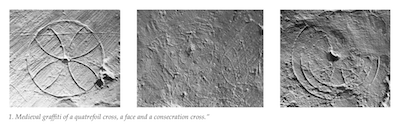 Fig 1.
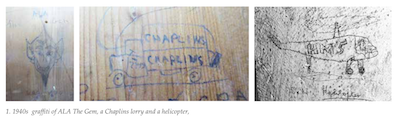 Fig 2
Fig 2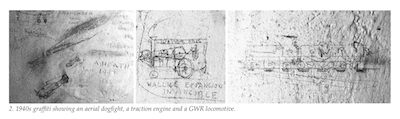 Fig 3
Fig 3