
| Programme of EventsMembershipPublicationsEditorial BoardOfficers | Library | Medieval Graffiti Survey |
|
|
Hampshire Field Club & Archaeological Society |
| Registered Charity number 243773 | HomepageArchaeologyHistoric Buildings Hampshire Papers LandscapeLocal History |
 |
St Andrew’s church, TimsburyPost code: SO51 0NA OS Grid Ref: SU347246 CoE CHR No: 641294
The cursory description in Pevsner’s The buildings of England. Hampshire: South (2018), which concentrates on the 2014 fire, does little justice to this fascinating church. The church is medieval in date, with a 16th century porch, and its interior includes some historical gems. The wall paintings which survive on the walls of the nave are spectacular. On the south wall these show a range of contemporary (early sixteenth century) timber framed buildings, of which there is only one other example in the country. On the north wall are Tudor roses, traces of black lettering, and a small area depicting plants and rushes which could be the lower part of a St Christopher scene. SummaryGraffiti is found in many locations around the church building. On the exterior, it consists of initials and names, some dated, inscribed into the surfaces of the quoins and window surrounds. Many of these marks are very weathered. Inside, there are concentrations around the window frames and sills of the south and north chancel windows, including marks thought to represent Marian devotional symbols. The font, shattered by the falling bell during the fire, has been carefully repaired and has many initials dating to the seventeenth and eighteenth centuries incised into it. Masons’ marks, and carpenters’ assembly marks were also found, and taper burn marks on the rood screen. ExteriorThe main areas of graffiti are around the chancel windows. They mainly comprise initials and dates. Pairs of initials WB and WO with the date 1811 are on the west side of the north chancel window (Photo 1). More sets of initials and some elaborate shapes are on the west side of the south chancel window.
The remains of a scratch or mass dial, noted by Green (1943), are on a block at the south-east angle of the chancel, with a small cross incised above (Photo 3).
The Church DoorThere is graffito in the form of an upward-pointing arrow on the outside face of the wooden door, above the end of the top hinge (Photo 4). Near the arrow are some faintly incised X shapes. The initials EH are carefully carved into the east side of the door frame.
The Interior
On the interior fabric of the church most of the graffiti is clustered around the north and south windows of the chancel. The most significant finds are 2 initial Ms, very carefully incised in Gothic script, one on each window surround, on the north window to the east (Photo 6), and on the south window to the west. Each letter has a plant-like stem rising up from the central bar.
The FontThe repaired octagonal font (Photo 7) retains most of the graffiti which was scratched into its sides, although some has been lost. The graffiti consists of initials and 17th and 18th century dates.
The most clearly cut and largest inscription is on the south-west face, reading MI 1681 (Photo 8).
The Rood ScreenThis is a relatively rare survival in Hampshire, one of only ten in the county. While no graffiti was found, on the south side of the outer frame, on the west face are some burn marks (Photo 9). Such marks, once dismissed as the result of careless accidents with candles or tapers, have, following a detailed programme of archaeological experimentation, been demonstrated by Dean and Hill (2014), to more likely have been made deliberately. Although the motives for making such marks remain unclear, it has been suggested that they served some sort of apotropaic function, perhaps against fire, in this building, with only partial success.
The PewsThe 14th century pews are another rare occurrence in a Hampshire church, one of only two sets known. Unsurprisingly, they have graffiti on them, including some small compass-drawn circles, and initials. Perhaps of more interest are the longer, rough lines found on some of them which are reminiscent, although cruder, of carpenters’ assembly marks, and perhaps were made to assist with construction (Photo 10).
Survey Archive164 photographs were taken during the survey. All images and record sheets are held by the Hampshire Field Club Medieval Graffiti Project archive and are available on request. A copy of this report has been lodged with the Hampshire Historic Environment Record and with the church, and reports have been posted on the HFC and SAS websites. DisclaimerThis document has been prepared for the titled project or named part hereof and should not be relied upon or used for any other project or assessment without the permission of the Hampshire Medieval Graffiti Project or the church. See further images and read the fuller pdf report. Survey date: 26th May 2023. Surveyors: Ron Brading, Sarah Hanna, Karen Parker, Sue and Derek Stewart, Karen Wardley, Brian Webb | |
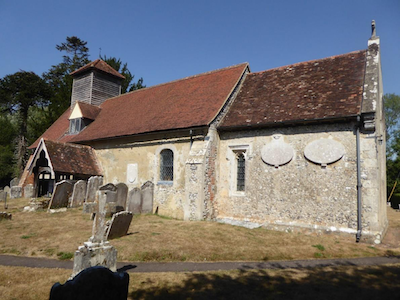 Photo 1 - Exterior of the church.
 Photo 2 - Initials on the Chancel window.
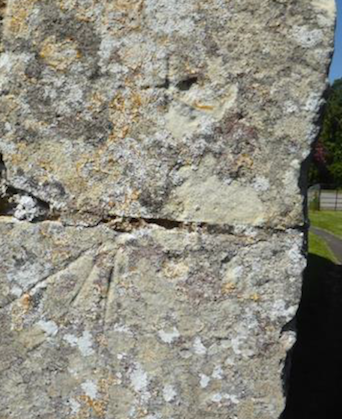 Photo 3: Scratch or mass dial.
 Photo 4: Upward pointing arrow on the church door.
 Photo 5: The interior of the church looking east.
 Photo 6: Incised gothic M.
 Photo 7: The octagonal font.
 Photo 8: Inscription on the south-west face.
 Photo 9: Burn marks on the Rood Screen.
 Photo 10: Possible carpenter's marks.