
| Programme of EventsMembershipPublicationsEditorial BoardOfficers | Library | Medieval Graffiti Survey |
|
|
Hampshire Field Club & Archaeological Society |
| Registered Charity number 243773 | HomepageArchaeologyHistoric Buildings Hampshire Papers LandscapeLocal History |
 |
St James Without-the-Priory Gate, Southwick
Members of the Hampshire Medieval Graffiti Project visited St James church, Southwick on 3rd May 2019 to locate, photograph and record the historical graffiti there. The original church here was medieval in date, or even earlier, but the current building was substantially restored in the 1560s by John Whyte, who acquired much of the Southwick Estate after the dissolution of the monasteries in 1538 and utilised much stonework from the Priory in his revamped church.
The most common type of graffiti found on our surveys is the cross. These are often found near church entrances, possibly made as signs of devotion by those entering. Here, there are two on the archway leading into the vestry, which was the original south entrance into the church. (Photo 3 below)
Another common form is the hexfoil or daisy wheel, a compass-drawn shape which had an apotropaic or ritual protection function, guarding against evil spirits and the Devil. At Southwick we found two of these on the arcading from the Priory, now in the vestry. They are faint and hard to see without a raking light, but are almost certainly pre-Reformation. Another clearer example is on the canopy of the tomb of John Whyte, who died in 1567. (Photo 4 below) So this is later in date, demonstrating the continuity of the use of these marks. Another fragmentary one is on the octagonal pillar opposite the vestry entrance.
Post Reformation, as literacy increased, people often left their mark in the form of initials and dates. We did not find so many of these at Southwick, although there is a nice example of an elaborately conjoined set of initials, MB, on the NW pillar supporting the Whyte tomb canopy. (Photo 5 below)
On a mullion of the west window are the initials EM, enclosed in a square, and IC is inscribed on the sill. There is also what could possibly be a music stave of five lines inscribed onto one of the mullions. (Photo 6 below) If so, this would be a relatively rare find. An image of this graffito has therefore been sent to the Digital Image Archive of Medieval Music (DIAMM) at the University of Oxford, who are collecting such examples.
The font holds a wealth of interesting graffiti, all incised into the rim of its lead lining. This includes a carefully chiselled name, which is hard to decipher exactly, but looks like W RalPH. This name appears next to two hand outlines, which again have been carefully chiselled, in a form known as “wriggle work” which was a common decorative device on seventeenth century pewter, suggesting this was the date when these hands were traced. (Photo 7 below) They are both left hands, suggesting the owner held the chisel or implement in their right hand to make the mark. They are quite small and slender, suggesting they could belong to a woman. Their significance isn’t certain , but people have been leaving hand prints in sacred places since Palaeolithic times, and they certainly represent a very personal and unique mark. The font lead contains much more graffiti, including initials, crosses and geometric shapes.
On the sill of the most westerly window in the north aisle is a group of graffiti which could include a crude representation of a sailing ship with a flag, although this is open to interpretation! On the north side of the most easterly window in this aisle is an interesting conjoined diamond pattern, which is very similar to one found at St Cross in Winchester. (Photo 8 below) Its significance however is unknown.
As well as graffiti, we record other marks such as masons’ marks. We found an interesting group of these at Southwick, all in the form of an arrow, possibly indicating that they were contemporary and the work of one team of masons. (Photo 9 below) There is a very obvious one inside the west doorway, and others are visible at different locations around the exterior, for example to the west and east of the former south porch and on the NE corner buttress.
The team also visited the site of Southwick Priory where the patched-up north wall of the refectory still stands. (Photo 2 above) No graffiti was found here. We are very grateful to the Reverend Simon Brocklehurst, the church wardens and parishioners of Southwick for allowing us access to the church and making us so welcome. We are also grateful to the survey team from the Arts Society who initially alerted us to the presence of graffiti here and kindly provided us with a floor plan.
Survey date: May 2019 Report by Karen Wardley | |
 Photo 1 - St James, Southwick.
 Photo 2 - Ruins of Southwick Priory
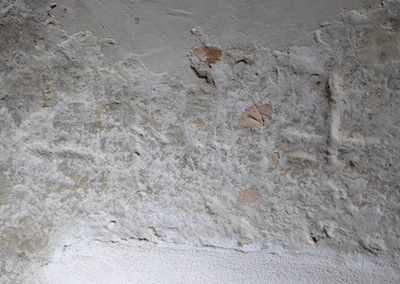 Photo 3 - Crosses near the vestry
 Photo 4 - Hexfoil on tombe of John Whyte.
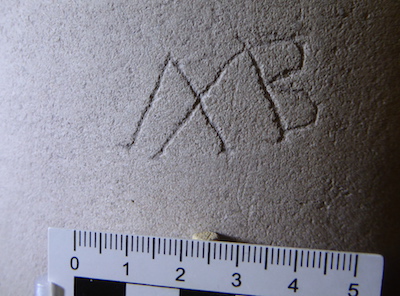 Photo 5: Example of initials
 Photo 6: Possible music stave?
 Photo 7: Hand outline on lead of the font.
 Photo 8: Diamond pattern on window.
 Photo 9: Masons' mark.
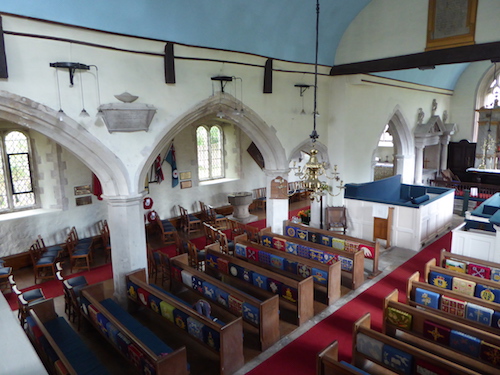 Photo 10: interior of the church.