All Saints, Crondall
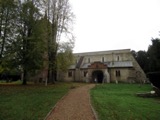
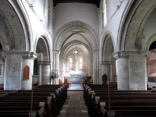
All Saints is an Anglican parish church in the village of Crondall, at the north-east edge of Hampshire. It is a Grade I listed building and stands at the highest point in the village. Although a Saxon church was mentioned in the Domesday Book, the present church dates from 1170 – Norman Transitional period. It consists of a nave with north and south aisles containing chapels, and a chancel. There had previously been a tower over the east end of the nave but this was removed in 1657 and replaced by the current brick structure alongside the chancel. There is an entrance porch on the north side.
Some interesting graffiti was discovered: several crosses (below left) which are well known to the church, together with a triangular design (below right), possibly a depiction of the church?, were found around the north doorway.
 |
|
 |
| Example of crosses |
|
Triangular graffito |
There are a number of marks on the pillars - a possible hand drawn spoked wheel (below left), apotropaic marks of two compass-drawn crosses and a butterfly (below right) all on a pillar on the north side of the chancel.
 |
|
 |
| Spoked wheel |
|
Compass-drawn crosses & butterfly |
Most of the pillars in the north aisle contain initials, names and dates (below left). Significant amounts of graffiti were located within the Paulet tomb of 1558, situated in the chancel, including many apotropaic marks, faces, names and dates, much of it overlapping. A large shield with a name and date (below right) also appears on the tomb.
 |
|
 |
| Name & date on pillar |
|
Shield with name & face |
A team from Southampton Archaeology Society visited the church on 18th October 2018. The team consisted of Gill & Roger James, Sue & Derek Stewart, and Joan & Brian Webb. The report was written by Joan & Brian Webb on 25th October 2018
|