| Programme of EventsMembershipPublicationsEditorial BoardOfficers | Library | Medieval Graffiti Survey |
|
|
Hampshire Field Club & Archaeological Society |
| Registered Charity number 243773 | HomepageArchaeologyHistoric Buildings Hampshire Papers LandscapeLocal History |
 |
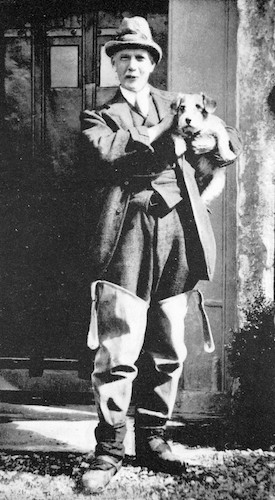
Celebrating Hampshire HistoriansPlunket Greene, Harry24 June 1865 – 19 August 1936Plunket Greene was born in Dublin, son of Richard Jonas Greene, barrister, and his wife Louisa Lillias (neé Plunket) a writer of children's stories. He was educated at Clifton College, Bristol and set aside a career in law on account of a severe rugby football injury. With his evident musicality, however, and the development of a promising voice, he studied singing in Dublin, Stuttgart, Florence and London, making his first public appearance in 1888. Over the next few decades, he made his name as a refined interpreter of songs and was credited as the creator of the song recital. His singing of Schubert, Schumann and Brahms was especially admired, and he toured continental Europe, as well as making several visits to Canada and America. But there was another great passion in his life – fly fishing. In his autobiographical ‘Where the Bright Waters Meet’ he describes how he discovered the Hampshire Bourne ‘in those days unquestionably the finest small trout stream in England’. An initial sojourn in Whitchurch, in 1900, led him to Hurstbourne Tarrant. Two years later circumstances contrived to take him back to the village and he was to make it his home for the next decade. Whilst his recollections are dominated by his fishing expeditions, Plunket Greene has a lot to say about the social life of the village, from the benevolence of the landlord, Lord Portsmouth, to the friendliness of the community, who were ‘like a big family party’. Cricket matches also feature, with Hurstbourne often entertaining London teams who had quality players in their ranks. Plunket Greene’s world is undeniably ‘upper class’ and though he can be found crawling through bushes and sloshing through mud in pursuit of his sport, his fellow anglers are invariably the product of the public school system. Nevertheless, he has much to say about ‘The Tragedy of the Bourne’ whether as a result of overstocking in 1905, the arrival of the ‘acres and acres of watercress beds, laid out with a ghastly precision between long lines of concrete walls’, or the pollution caused by tar on the road bridge oozing into the water in the 1920s. Essentially, his story is one of a man experiencing an idyllic existence – as work and other commitments allowed – in a world that was changing and disappearing before his eyes. He married (1899) Gwendolen Maud, younger daughter of Sir C. H. H. Parry, director of the Royal College of Music; they had two sons and a daughter. Plunket Greene is buried in the churchyard at Hurstbourne Priors. Sources
Portrait
Contribution to county’s historyA somewhat particular view of the Hampshire Bourne with splashes of social history among the angling accomplishments. Relevant published works
Critical CommentsOther CommentsContributorDave Allen – May 2024 Key WordsBourne River, Hurstbourne, fly fishing Any queries or further suggestions for this part of the list should be addressed to celebrating@hantsfieldclub.org.uk.
| |
| Contact Any questions about the web site? Then email Webmaster |
||