| Programme of EventsMembershipPublicationsEditorial BoardOfficers | Library | Medieval Graffiti Survey |
|
|
Hampshire Field Club & Archaeological Society |
| Registered Charity number 243773 | HomepageArchaeologyHistoric Buildings Hampshire Papers LandscapeLocal History |
 |
Celebrating Hampshire HistoriansPledge, Frederick William17.09.1875 - 27.01.1942Born in London, Pledge undertook his higher education at Oxford University studying classics, history and French during the second half of the 1890s. Around the turn of the twentieth century and while he was in Scotland, Pledge’s path crossed with that of (Otto) Ernest Philippi. The latter had been born in Germany acquiring British Citizenship in 1872. By 1900 he had become the wealthy Managing Director of the cotton business J and P Coats Ltd of Paisley in Scotland. That year he purchased Crawley Court, to where he moved with his whole family and Frederick. Due to his younger son, George’s ‘weak constitution’ and his preference for having him ‘educated at home’, he had engaged Frederick as his tutor. Until his death in 1917 Ernest spent a great deal of his wealth and energy on not only renovating Crawley Court, but also buying up and refurbishing many dilapidated properties in the neighbourhood to create a ‘model village’. Contact with the Philippi family resulted in Frederick meeting his future wife, Clara, who had been born in Germany. By 1911 the couple were living in the Manor House Crawley, courtesy of Ernest Philippi. Here were also accommodated students who Pledge ‘crammed’ for University entrance exams. All the evidence indicates that Frederick and Clara immersed themselves in the life of the village where they lived until the early 1930s. For example, Frederick was a member of the Parish Council from 1904 to 1934 and also provided administrative assistance at the village school. He also found time to research the history of Crawley privately publishing the results in 1907 (see below). His commitment is confirmed by a history of the village published by two American academics in 1930 (see below). ‘There is in the Village of Crawley a tutor, F.W.Pledge esq., M.A., who has lived in Crawley for over twenty years and who prepares young men for Cambridge and Oxford. The young men are in residence with their tutor during the few months necessary. Mr Pledge lives in the old Pern house, now called Manor House. Thus do residents take the place of yeomen farmers’ (p.151). Later under they heading ‘Notable Personalities’ they describe Pledge as a ‘modest scholar who looks out upon the world with calm judgement, getting his abiding satisfactions from the simpler things of life’ (p.159). Evidence from electoral registers indicates that for much of the 1930s Frederick and Clara lived in Eastbourne. However, it would seem that by the early 1940s they had moved back to the Winchester area where his death was registered. Sources
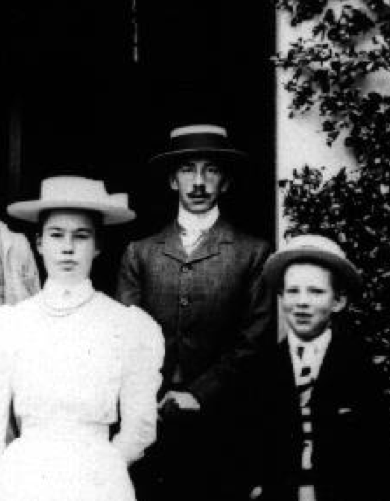
Portrait.
Contribution to county’s historyPledge’s history of Crawley serves as a model village/parish history published in the first decade of the twentieth century. It is a scholarly work and includes chapters, inter alia, on Medieval Village Life; the Black Death, the “Great House” and its owners; the Churchwarden’s accounts; and the Parish register. Moreover, in their different ways, later historians of Crawley, namely NS and EC Gras (see below), Ian Henderson and David Dunbar all owed something of a debt to Pledge’s pioneering work. Relevant published works
Critical CommentsUnfortunately Pledge did not provide a Preface to his book setting out the background to, and motivation for, its preparation and the approach adopted. Moreover, given the timing of his publication there does not appear to have been any collaboration between his research and that undertaken for the VCH, with the volume covering Crawley being published in 1908. Other CommentsThe book by Norman Scott Brien and Ethel Cuthbert Gras is a significant postscript to Pledge’s work on Crawley. These two American academics chose Crawley as the subject of what was, in their words, a ‘chiefly documentary’ study of the history of a English village because it possessed certain characteristics. These included being situated in ‘an older and long settled part of England’ and ‘located near enough to a town (the city of Winchester) to have come very early under urban influence’ (p.i). Acknowledgement is also given to Pledge’s ‘excellent general history of the village.’ Moreover, Pledge contributed a short item on the changes in village life since the publication of his book (pp.698-702). ContributorRoger Ottewill (3 May 2024) Key WordsCrawley Court, Crawley Any queries or further suggestions for this part of the list should be addressed to celebrating@hantsfieldclub.org.uk.
| |
| Contact Any questions about the web site? Then email Webmaster |
||