| Programme of EventsMembershipPublicationsEditorial BoardOfficers | Library | Medieval Graffiti Survey |
|
|
Hampshire Field Club & Archaeological Society |
| Registered Charity number 243773 | HomepageArchaeologyHistoric Buildings Hampshire Papers LandscapeLocal History |
 |
Celebrating Hampshire HistoriansMilner, John14 October 1752 – 19 April 1826The relationship between John Milner and Winchester printer and ‘respectable bookseller’ James Robbins (1761-1844) is an early example of a ‘publisher and his author’. When Robbins asked him to write ‘a faithful account and description of Winchester’ he did so. It was a risky match, a Catholic priest and a young untried printer, but the resulting two volumes of The History, Civil and Ecclesiastical, and Survey of Antiquities of Winchester sold well over several decades. They were well researched, well written and well produced, with drawings by local artist James Cave. There is a freshness, even brashness in Milner’s style. For example, in the early pages of the first volume he criticizes the writing of history which ‘is too often disgraced’ in the hands of those who ‘spend their lives in minute and uninteresting investigations and enumerations’. Apparently, he expected the exercise to involve extending and correcting earlier publications, but in the event found that a completely new work was required. Hence, in a way that was ahead of its time, he spent several pages ‘reviewing the literature’ of earlier publications and manuscripts. The main thrust of his work was to forensically correct the record, yet also to use Winchester as a vehicle for reinterpreting the history of the country from a Catholic perspective. He gloried in its great Gothic cathedrals and poured scorn on its recent past. In particular, one sentence he wrote about a former bishop of Winchester, Benjamin Hoadly – renowned for the Bangorian controversy – hit a raw nerve in the Anglican community. Commenting on the way his memorial in the cathedral had been cut into a pillar, and on the bishop’s ‘low church’ credentials, he wrote: ‘Thus it may be said with truth of Dr Hoadly, that both living and dying he undermined the church of which he was prelate.’ Uproar! Cathedral canon and chancellor John Sturges (1736-1807), responded with Reflections on the Principles and Institutions of Popery Occasioned by Milner’s History of Winchester. Milner replied with a 300-page response, Letters to a Prebendary, Being an Answer to Reflections on Popery. Both were published by Robbins, who was clearly enjoying a print war that would do nothing but increase sales of Milner’s various works, which were listed at the end of his Letters. He also capitalized on the situation by producing a number of spin-offs, including a guidebook, A Short View of the History and Antiquities of Winchester, which went through 11 editions until 20 years after Robbins’ death. Other spin-offs included An Historical and Critical Account of Winchester Cathedral and A Short Description of the History and Antiquities of St Cross near Winchester, which went through 22 editions. On top of all this, after Milner’s death the main work in two volumes went into a third edition published in 1839. (His success with Milner may have encouraged him to take on the task of publishing the Hampshire Chronicle in 1805, only to relinquish it to two of his former apprentices in 1813.) Milner, who for 11 years had trained as a priest in the English College, Douai, came to Winchester a decade before the French revolution to replace a priest who had died of fever administering to the hundreds of French Catholic prisoners held in the city. As well as his life as a priest, Milner published many controversial essays and pamphlets on religious subjects and also, as an amateur antiquarian, contributed articles to Archaeologia and other journals. He was fiercely opposed to the Cisalpine movement in the Catholic church, a liberal arm that sought emancipation by pledging loyalty to the crown as well as allegiance to the pope. He also attacked low-church protestant dissenters and for a while he sided with Anglo-Catholics in a successful campaign to remove the phrase ‘protesting Catholic dissenters’ from the Catholic Relief Act of 1791. Shortly after the act, he started to build a church, now called Milner Hall, tucked away in St Peter Street (recorded in detail in the second volume of his main work, p. 83), which claims to be the first Catholic church consecrated after the Reformation. In 1803 he was moved to the Midland District of the Catholic church as Vicar Apostolic, with the title of Bishop of Castabala, a city now in Turkey. Sources
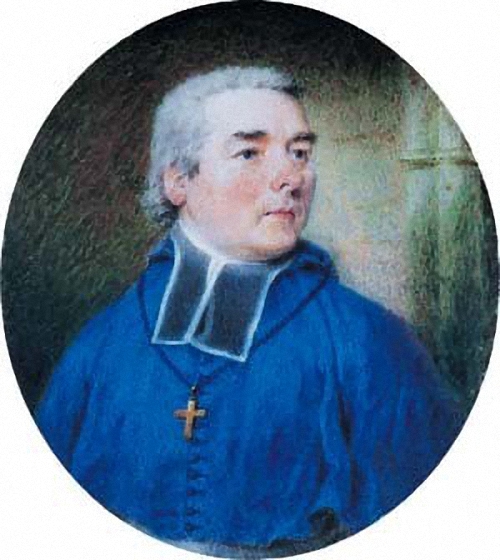
Portrait
John Milner, 1808, miniature by George Anthony Keman (St Mary’s College, Oscott, Birmingham) Contribution to county’s historyHis two-volume magnum opus was for long a major work of reference. Modern scholars regard it as ‘well founded’, with ‘a view of Winchester…only just emerging from the conditions which had prevailed since the end of the Middle Ages’ (D. Keene, Survey of Medieval Winchester, Vol 1, 1985, p. 33). Its main significance now is as an element in the Catholic-Protestant schism that underlies so much of English history. His business relationship with James Robbins spawned an historic guidebook industry that goes on. Relevant published works
The British Library Catalogue lists many other works by Milner. Critical CommentsMilner was obviously a careful scholar within the limitations of his age. Constrained by firmly held beliefs, he was even controversial within his own church. Other CommentsContributorBarry Shurlock, 15 February 2023 Key WordsWinchester, Winchester Cathedral, St Cross Winchester Any queries or further suggestions for this part of the list should be addressed to celebrating@hantsfieldclub.org.uk.
| |
| Contact Any questions about the web site? Then email Webmaster |
||