| Programme of EventsMembershipPublicationsEditorial BoardOfficers | Library | Medieval Graffiti Survey |
|
|
Hampshire Field Club & Archaeological Society |
| Registered Charity number 243773 | HomepageArchaeologyHistoric Buildings Hampshire Papers LandscapeLocal History |
 |
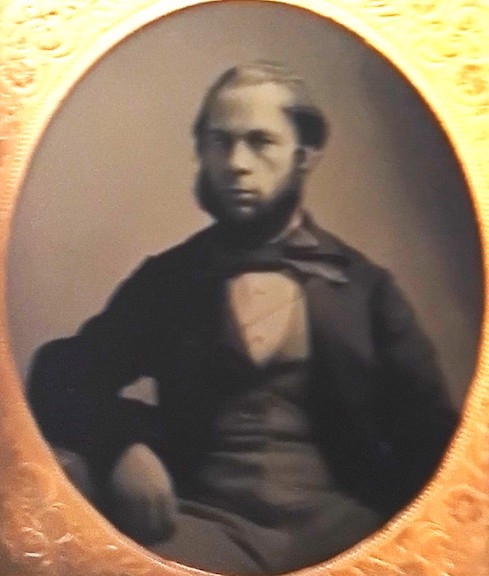
Celebrating Hampshire HistoriansKing, Edward18.10.1821 - 12.03.1885Edward King was born in Lymington, the son of Richard and Elizabeth King. He was educated at Amsterdam House, Christchurch, before joining the family business in the town, which was an offshoot of his grandfather’s printing business in Yeovil. One member of the family, Charles, had moved to Lymington in 1805, and his nephew, Richard (Edward’s father) joined him in 1817. In 1845, at about the time of his father’s second marriage, Edward moved to London; he married Susan Ailes at St Pancras in 1849, and lived in the parish of St George the Martyr, Middlesex. In 1855, on his father’s retirement, he returned to the business, which three years later moved from 126 High Street to 105-6 High Street. It remained there until sold to four employees in 1988; the shop is now a branch of Waterstones. The 1861 census shows him as ‘bookseller and printer employing 1 man and 3 boys’, with the family literally ‘living over the shop’, which they did until his death. Edward’s father, Richard, had printed the historically valuable A New Guide to Lymington, by A Resident in 1827, with revised editions in 1828 and 1841. He had encouraged the author, but, contrary to some claims, had not written the book (possibly it was a friend of his, Dr William Towsey). It was Edward who later combined business with historical writing, but only after making his mark in local politics. A member of Lymington Borough Council from the 1860s, he was three times Mayor: in 1871/2, 1872/3 and 1878/9, thereby ‘devoting much time to the public good’, according to his obituary in the Lymington and South Hants Chronicle (26 March 1885). In the Preface to his major contribution to local history, Old Times Revisited in the Borough and Parish of Lymington, first published in 1879, King comments: ‘I must have been born an antiquarian; for I can recollect in early childhood making earnest inquiries about the recollections of aged relatives as to the stirring times of the French Revolution and the Foreign Emigres. ... the reader may be sure I never assert anything that is without foundation. …My connection with the Town Council has enabled me to go, in every case, to the original Books and Documents.’ He also points out that he ‘picked up the baton’ from Charles St Barbe, who had begun collecting documents for the purpose of writing a history of Lymington, but ‘was far advanced in life; and ... had scarcely commenced when, increasing infirmity, and death, arrested his labours.' Sources
PortraitContribution to county’s historyIn researching and writing what was at the time a definitive history of Lymington, King indicated his motivation in a way which reflects one of the underlying purposes of local history: ‘Connected with every locality in England there are numerous facts, which, being below the dignity of history; tend quickly to be forgotten, though they become in after years, subjects of great interest to the inhabitants. Without them the past is a mere blank; but when they are recalled into existence by the medium of the press, bygone years and long forgotten individuals start again into life and remembrance.' In this respect, he was one of a few individuals in Hampshire who were beginning to take a serious interest in local history. It is significant that his work embraces not only Lymington’s history from its earliest days to the nineteenth century, but also aspects of its social, economic and political life, as well as its architectural heritage. As his obituary put it, ‘in his excellent account [Old Times Revisited] ... [he] showed that he was an antiquary of no mean order, and his book will form his enduring memorial in his native town.’ Relevant published works
Critical CommentsAs a former mayor of Lymington, Edward King had ready access to the records of the Corporation and also the parish records at St Thomas’ Church, Lymington. Additionally, as detailed in in the Preface to Old Times Revisited, he made use of material from the sons of his friend, Charles St Barbe, although he stressed that he rechecked all the details before committing them to print. Edward King’s namesake grandson wrote his own book, A Walk Through Lymington - A Sentimental Journey (Lymington, Kings of Lymington Ltd, 1972), adding new material and his own reflections. King did not index Old Times Re-Visited, but this was done, and a few corrections made, by A. T. Lloyd in Lymington Index of Local History: Based Chiefly on King's Old Times Re-Visited and Bibliography, Buckland Trust, Lymington, 1992. Lloyd (1917-2009) was a local historian and teacher of history (https://en.wikipedia.org/wiki/Arthur_Lloyd_(historian)) Other CommentsAfter the sale of the business in 1988, the King family retained a substantial archive of valuable historical records relating to the town. This archive was donated to St Barbe Museum and Art Gallery (founded in 1999) by Mrs Janet Irvine on the proviso that a research facility would be established. The opportunity for this was finally realised in 2015 following a major refurbishment and reorganisation of space. This allowed the research facility to be opened as The Kings Research Room. ContributorRoger Ottewill and St Barbe Museum volunteers (11 June 2024); revised Barry Jolly (11 August 25) Key WordsLymington, local history Any queries or further suggestions for this part of the list should be addressed to celebrating@hantsfieldclub.org.uk.
Back to Historians I-L from Innes, Kathleen to Luce, Sir Richard | |
| Contact Any questions about the web site? Then email Webmaster |
||