| Programme of EventsMembershipPublicationsEditorial BoardOfficers | Library | Medieval Graffiti Survey |
|
|
Hampshire Field Club & Archaeological Society |
| Registered Charity number 243773 | HomepageArchaeologyHistoric Buildings Hampshire Papers LandscapeLocal History |
 |
Celebrating Hampshire HistoriansHope, William Henry St John1854 – 18 August 1919William Hope was born in Derby, the son of Rev William Hope and his wife Hester (neé Williams) and educated at Derby Grammar School before going up to Peterhouse, Cambridge. He graduated with a BA in 1881, received his MA in 1884 and the following year became Assistant Secretary at the Society of Antiquaries. This appointment found him perfectly placed when General Pitt Rivers, encouraged by the work of the late Rev James Joyce at Silchester, persuaded the third Duke of Wellington to allow the Society to mount a major project there. This started in 1890 and ran for 20 years, with Hope as director, accompanied by George E Fox, an artist cum architect and student of Roman Britain. Every year the season’s work was reported in the Society’s journal, Archaeologia, with an ever-expanding picture until, in 1908, the area within the walls had been sampled in such a way that a comprehensive plan of the town could be appreciated. Not all finds were retained, but the remarkable collection, from complete mosaics to delicate personal items was, at the initiative of Joseph Stevens, loaned to the Reading Museum, where it still takes pride of place today. Although the interim reports on Silchester total nearly 400 pages, no overall account was produced by Hope, but by this time he had many other projects to attend to, including some in Hampshire. The Making of Place House at Titchfield, near Southampton, in 1538 and The Cistercian Abbey of Beaulieu in the County of Southampton (with Harold Brakspear) were both published in 1906, as was The Episcopal Ornaments of William of Wykeham and William of Waynfleet, sometime Bishops of Winchester, and of certain Bishops of St Davids. Hope’s major work was an Architectural History of Windsor Castle, begun in 1893 and completed 20 years later, an achievement for which he was knighted. He also worked with Brakspear at Ludlow Castle, Lewes and, between 1909 and 1915, took part in the first major excavations at Old Sarum. Hope married Myrrha Fullerton in 1885 and they had a son. Following her death in 1903 he later married Mary Jeffries. Hope’s outstanding contributions to both history and archaeology were noted by the Society of Antiquaries at their April 1920 meeting: ‘In addition to superintending many excavations…there were few subjects dealing with medieval archaeology on which he did not make himself an authority and the wide range of his interests may be judged from the fact that among his published writings were books on the Stall plates of the Knights of the Garter, on Corporation Plate, on Inventories of Christchurch, Canterbury on English Altars and on the English Liturgical Colours.’ Sources
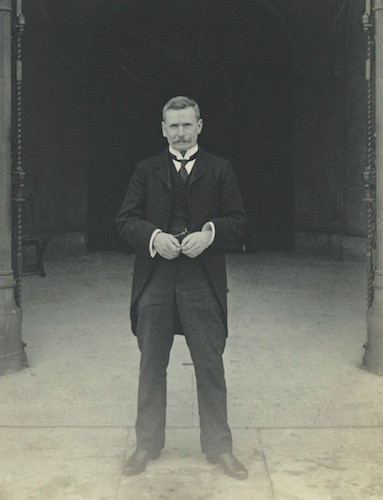
Portrait
Contribution to county’s historyHope directed the Society of Antiquaries excavations at Silchester – following in the footsteps of Rev James Joyce. His work concentrated on revealing a complete layout of the streets and insulae of the Roman town, producing a plan of Calleva c AD 300 and thereby leaving the more deeply stratified earlier material for later investigators. Relevant published works
Critical CommentsOther CommentsContributorDave Allen - May 2024 Key WordsSilchester; Beaulieu; Titchfield Any queries or further suggestions for this part of the list should be addressed to celebrating@hantsfieldclub.org.uk.
Back to Historians G-H from Gallup, Peter to Hudson, William Henry | |
| Contact Any questions about the web site? Then email Webmaster |
||