| Programme of EventsMembershipPublicationsEditorial BoardOfficers | Library | Medieval Graffiti Survey |
|
|
Hampshire Field Club & Archaeological Society |
| Registered Charity number 243773 | HomepageArchaeologyHistoric Buildings Hampshire Papers LandscapeLocal History |
 |
Celebrating Hampshire HistoriansHervey, Thomas - Rev.1817 - 1901In some ways, Thomas Hervey fits the classic model of the well-educated clergyman, with a country living remote from any town, who spent much of his time delving into the history of his parish, aided by the parish records close at hand. In other ways, he was a one-off, demonstrating some rare talents for a local historian. His father Romaine (c.1773-1837) grew up in Westmorland and won a scholarship to Magdalene College, Cambridge, which set the pattern for the family: Thomas went up to Clare College, his brother – who became a school teacher – to Emmanuel College, and Thomas’s son, Alfred Cyril (b. 1848), also to Clare (in 1845 Thomas had married Anne Hirst in York). After curacies at Woodhouse, Leeds, and Hawkshurst and Newenden, Kent, in 1853 Thomas (or possibly his mother, Elizabeth, HRO, 35M48/6/1512) purchased the advowson of Colemore (then spelled Colmer) and Prior’s Dean in East Hampshire. It had been held by the Abbot of Hyde until the early 16th century, after which it passed to a succession of owners. He remained its rector until his death in 1901, when he was followed by his son Alfred, who had been biding his time as a curate in a succession of Hampshire parishes. Thomas’s main contribution to local history came after he had been at Colemore for nearly 30 years. He had earlier privately printed and published an intriguing title, Troubles of the English Church, 1859-1872, which is a collection of his articles, mainly from The Union and The Church Review. It is beautifully produced, with decorative headings and dropped capitals. He clearly was deeply involved in church politics and wrote in an easy, entertaining, almost Hardyesque style. For example: ‘Muddleton now rejoices in a handsome church; galleries and pews have disappeared; and what is more the Muddletonians are pleased with it and the service.’ In the following year he published a work on the early bishops of Winchester. In 1880 A History of the United Parishes of Colmer and Priors Dean followed, with a second edition slightly differenty titled in 1891 (pp. 331-350 cover his personal and family history). It is a substantial work of nearly 300 pages, with his own photographs and line drawing (possible also his), set and laid out in very professional manner, with his signature in the prelims. It had all been set and printed at Colemore, and was limited to 47 copies. When Oliver and Collins studied the economic and manorial history of Colemore and Prior’s Dean in 1976 they described Hervey’s work in detail, but made ‘as little use as possible’ of it – presumably to focus on primary sources. Between 1863 and 1889 he edited the Winchester Diocesan Calendar, giving way (with no apparent bitterness) to a rector of Monk Sherborne, who had started to publish his own calendar under another title! Sources
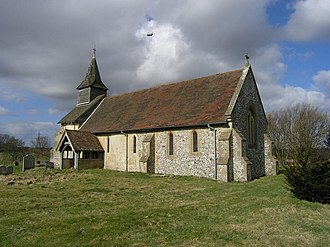
PortraitNone known, but this is a view of the church of St Peter ad Vincula, Colemore. Contribution to county’s historyLike many clergymen, he wrote the history of his own parish, but published it himself in considerable style. Relevant published works
Critical CommentsHis evident interest in the contemporary story of the Church of England perhaps made him more of a journalist than an historian, providing some fascinating insights into the politics of the Winchester diocese, yet to be studied. Other CommentsHe was not the only clergyman in the county to have his own printing press. An earlier example is the Rev Alex R.C. Dallas (1791-1869) rector of Wonston, who also owned a press, and sought to use it in his mission to convert the Catholics in Ireland to the Anglican faith. Colemore is now regarded as a ‘deserted village’, but is still occupied. ContributorBarry Shurlock, 2 February, 2024. Key WordsColemore, Priors Dean, printing, self-publishing, Winchester Diocesan Calendar Any queries or further suggestions for this part of the list should be addressed to celebrating@hantsfieldclub.org.uk.
Back to Historians G-H from Gallup, Peter to Hudson, William Henry | |
| Contact Any questions about the web site? Then email Webmaster |
||