| Programme of EventsMembershipPublicationsEditorial BoardOfficers | Library | Medieval Graffiti Survey |
|
|
Hampshire Field Club & Archaeological Society |
| Registered Charity number 243773 | HomepageArchaeologyHistoric Buildings Hampshire Papers LandscapeLocal History |
 |
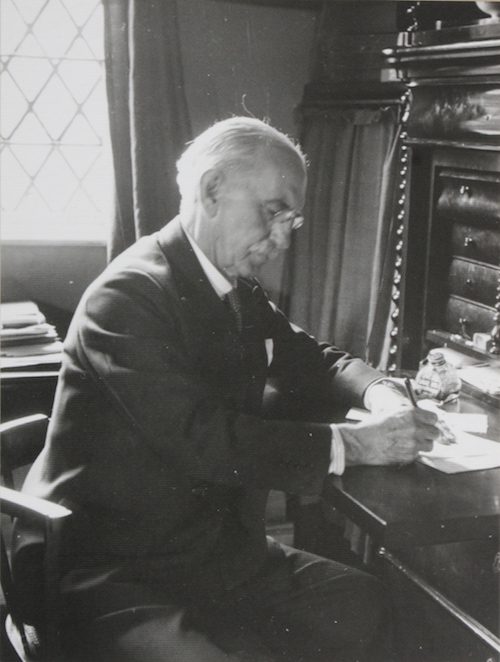
Celebrating Hampshire HistoriansGreen, Arthur Robert1866 - 1955Arthur Green was born in in 1866 in Bromsgrove, the eldest of three children of a prosperous grocer. He was a medical student in Edgbaston, Warwickshire in the 1890s. He qualified as a surgeon and set up in practice in Ledbury. He kept a large household in New Street, Ledbury. During the First World War he was too old for active service but extended his responsibilities for local medical care to fill the gaps left by those who did join up. He was voluntary medical officer to the hospital for the wounded in Ledbury. In the early 1920s he retired and moved to Croylands, Old Salisbury Lane, Romsey. He joined the Hampshire Field Club and became a very active member. He also became a Fellow of the Society of Antiquaries. He had a keen interest in the local history of Hampshire, particularly in church history and architecture. In 1934 he married Phyllis Hatton who became a close collaborator with him. Together they were instrumental in developing the Field Club Photographic section collecting and exhibiting photographs of Hampshire buildings. He published a number of books and several articles in HFC proceedings both individually and together with his wife. He seems to have been involved in many of the HFC field trips commenting on the church architecture (especially Saxon elements) and directed several full day trips himself. Three examples will give an indication of his commitment and engergy: In 1935, on 19th June (Wednesday) he directed a visit to Saxon Churches of Hampshire visiting Titchfield, Fareham, Boarhunt, Hambledon, Corhampton, Hinton Ampner, Tichborne, Headbourne Worthy – “The opportunity of visiting eight Saxon churches in one day was an exceptional one, and was taken by a large number of members." He followed this up in 1936 with a visit to Romsey Abbey and St. Cross Church, Winchester to look at Norman architecture. Then in 1937 the period of Early Gothic Architecture, as exemplified at Warblington and Chichester were considered. He also guided other groups round local churches eg The Literary and Philosophical Society visiting Embley Park round Wellow Church; and Southampton Rambling Club when they visited Michelmersh in 1938. In 1940s they moved to the Old Rectory, Stockbridge. In the 1950s they retired from HFC and Arthur died in Southampton on June 25th 1955. SourcesHis books, Census records, HFC proceedings, HRO catalogue Green’s papers - University of Southampton Special Collections GB 738 MS 75. Other papers are stored with the HFC’s photographic collection archives at HRO HFC 61/1-5 Portrait
Contribution to county’s historyHe recorded and analysed Hampshire churches and their architectural details. He contributed to Hampshire Field Club outings by explaining the churches visited. Together with his wife, Phyllis, he was instrumental in reviving the HFC Photographic section, coordinated the recording of Hampshire churches and other buildings from 1930s to 1950s. Relevant published works
Articles published in HFC Proceedings:
Critical CommentsMuch of his work is recording and describing although his work on mass dials includes analysis. Other CommentsAlways gave full credit to the opinions of other experts. Worked closely with his wife Phyllis both in acting as secretary to HFC Photographic section and in authoring the book on Saxon Architecture and Sculpture. ContributorMary & Roger Harris Key WordsMass dials, church architecture, photographic survey Any queries or further suggestions for this part of the list should be addressed to celebrating@hantsfieldclub.org.uk.
Back to Historians G-H from Gallup, Peter to Hudson, William Henry | |
| Contact Any questions about the web site? Then email Webmaster |
||