| Programme of EventsMembershipPublicationsEditorial BoardOfficers | Library | Medieval Graffiti Survey |
|
|
Hampshire Field Club & Archaeological Society |
| Registered Charity number 243773 | HomepageArchaeologyHistoric Buildings Hampshire Papers LandscapeLocal History |
 |
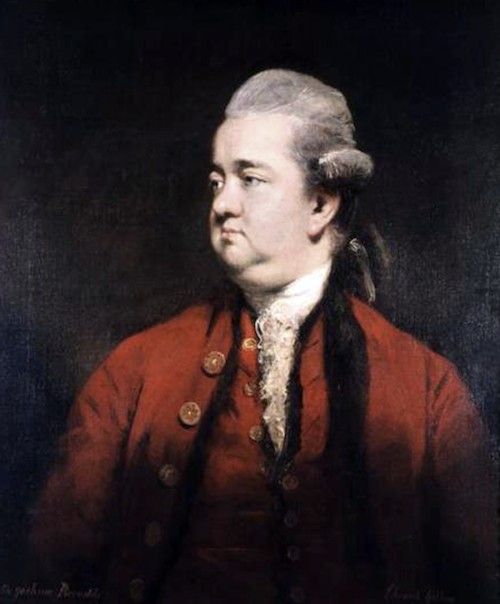
Celebrating Hampshire HistoriansGibbon, Edward8 May 1737 – 16 January 1794Edward Gibbon is best known for The History of the Decline and Fall of the Roman Empire published in six volumes by 1788, but he also served in the military and in Parliament, predominantly with Hampshire connections. By the end of his life, he was considered ‘a giant of the Enlightenment’, his work praised for its accuracy, thoroughness, clarity, and comprehensive grasp of a vast subject. Edward Gibbon was born at Lime Grove, Putney. He had six siblings, none of whom survived infancy. He himself was a puny child, apparently neglected by his mother, but nurtured by his adored ‘Aunt Kitty’. From 1747 onwards he spent time at the family home at Buriton and by 1751 he was reading the established histories. At the age of 15 his father sent him to Magdalen College, Oxford, where he endured an ‘idle and unprofitable’ 14 months and converted to Roman Catholicism. This, in turn, precipitated his removal to Switzerland, where he spent five intellectually productive years and reconverted to Protestantism in time to save his inheritance. From 1759 Gibbon served with the South Hampshire Militia, and Portchester Castle was briefly under his command, before embarking on a journey through Europe and finally reaching the ‘eternal City’. In 1765 he returned to Buriton, where he suffered five difficult years, but was able to start writing. With his father’s death he set himself up in London, where he began writing in earnest, but also entered Parliament, at first for Liskeard and later, Lymington. The first volume of what was to become his major work, was published in February 1776, and was very well received. Volumes II and III appeared in 1781, Volume IV in 1784, and the final two by June 1787. At this point, Gibbon felt that he had taken ‘everlasting leave of an old and agreeable companion’ and whatever ‘the future fate of my history, the life of a historian must be short and precarious’. Gibbon’s final years were not particularly comfortable, as life-long friends died, and his own health deteriorated. He succumbed at the age of 56 while staying with his great friend Lord Sheffield at Fletching in Sussex and was buried there in the Sheffield Mausoleum. SourcesPortrait
Contribution to county’s historyOne of the country’s finest historians, who lived in Hampshire, on and off, in the mid 18th century. Relevant published worksCritical CommentsOther CommentsContributorDave Allen, August 2022 Key WordsAny queries or further suggestions for this part of the list should be addressed to celebrating@hantsfieldclub.org.uk.
Back to Historians G-H from Gallup, Peter to Hudson, William Henry | |
| Contact Any questions about the web site? Then email Webmaster |
||